
How to Get a Cat in a Pet Carrier: A Calm, Stress-Free Guide
Getting a cat into a pet carrier can be surprisingly difficult. The moment the carrier appears, some cats disappear under the bed, while others resist with claws, vocalizations, or frantic attempts to escape.
This behavior is understandable. Many cats only see their carrier before an unfamiliar or stressful experience, such as a veterinary appointment, boarding stay, move, or long car journey. Over time, they can learn to associate the carrier itself with those experiences.
The good news is that carrier training can make transportation much easier. With patience, positive reinforcement, and the right technique, you can teach your cat to see the carrier as a familiar and secure space rather than something to fear.
Why Do Cats Hate Pet Carriers?
Cats generally prefer familiar environments and predictable routines. A pet carrier introduces several things that may make a cat uncomfortable: confinement, unfamiliar movement, unusual smells, car travel, and separation from its normal territory.
The problem can become worse when the carrier spends most of the year hidden in a closet or garage. If it suddenly appears only before a veterinary visit, your cat may quickly learn what comes next.
Veterinary guidance therefore recommends making the carrier part of the cat’s normal environment rather than bringing it out only immediately before travel. Familiar bedding, treats, toys, and food can all help create a more positive association with the carrier.
1. Choose the Right Cat Carrier
The process starts with a suitable carrier.
Ideally, a cat carrier should be large enough for your cat to stand, turn around, and lie down comfortably while remaining secure during transportation. Good ventilation is essential.
A carrier with both a front opening and a top opening can be especially convenient. Hard-sided carriers with removable tops are another useful option because a nervous cat can sometimes remain in the bottom portion of the carrier during handling or a veterinary examination.
Whichever design you choose, check that the doors and fasteners close securely before every trip.
2. Leave the Carrier Out at Home
One of the simplest ways to improve your cat’s relationship with the carrier is to stop treating it as travel equipment that only appears on stressful days.
Place the open carrier somewhere your cat regularly spends time.
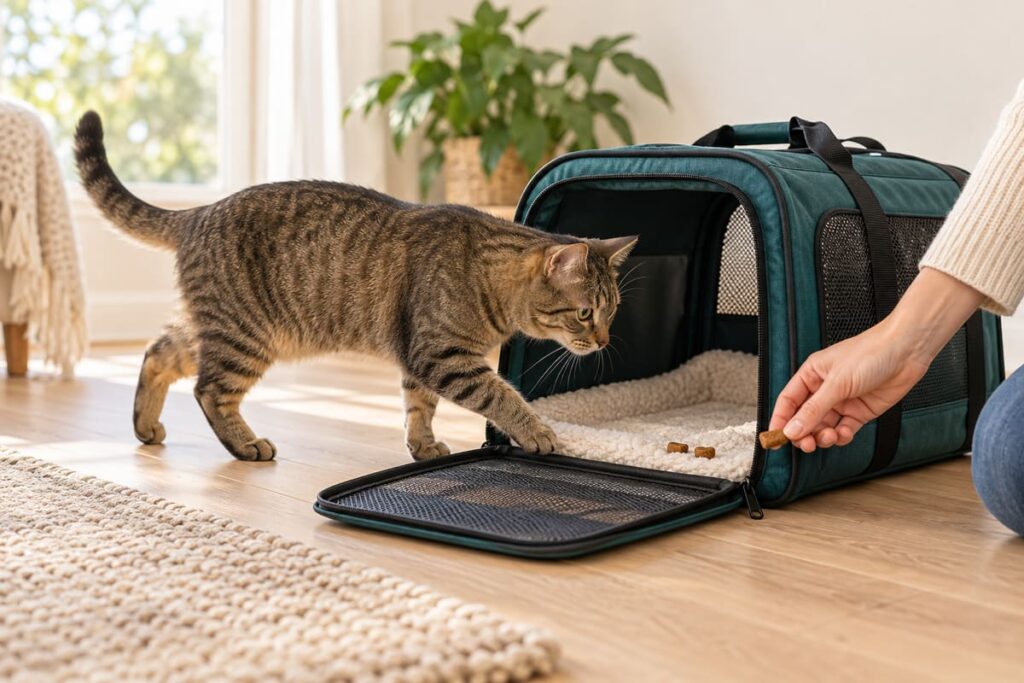
Add a familiar blanket, towel, or small bed inside. Leave the door open and allow your cat to investigate it voluntarily.
Some cats may ignore it initially. That’s fine. Avoid immediately picking up your cat and putting them inside. The first objective is simply to make the carrier an ordinary part of the home.
Over time, your cat may begin sniffing, exploring, resting, or even sleeping inside it.
3. Use Treats and Positive Reinforcement
Food can be extremely useful for carrier training.
Start by placing a few treats near the carrier entrance. Once your cat comfortably approaches, put the treats slightly farther inside.
Gradually move them toward the back.
You can also place a favorite toy inside or occasionally serve part of your cat’s regular meal in the carrier.
The idea is simple:
Carrier = something good happens.
Positive reinforcement helps replace the old association of “carrier means something scary” with a new association involving food, comfort, play, and safety. Veterinary behavior guidance specifically recommends treats, toys, food, and comfortable bedding as ways to encourage cats to voluntarily spend time in their carriers.
4. Practice Before You Actually Need the Carrier
Don’t wait until 15 minutes before a veterinary appointment to start carrier training.
Practice on ordinary days when nobody is in a hurry.
Once your cat willingly enters the carrier, briefly close the door. Give a treat, wait a few seconds, and open it again.
As your cat becomes comfortable, gradually increase the amount of time the door stays closed.
Later, practice lifting the carrier for a few seconds and putting it back down. Eventually, you can progress to walking around the house with it.
These small steps make the experience more predictable.
5. How to Put a Reluctant Cat Into a Carrier
Sometimes you don’t have several days or weeks for training. You may have an unexpected veterinary appointment or need to leave home immediately.
In that situation, preparation matters.
First, move the carrier into a small, quiet room with limited hiding places. Close the door so your cat cannot disappear underneath a large bed or piece of furniture.
Stay calm and move slowly. Avoid chasing your cat around the house, which can increase fear before the cat even reaches the carrier.
If you have a top-loading carrier, gently cradle your cat and lower them through the top opening.
For a hard-sided carrier with a removable top, another option is to remove the upper section, gently place the cat into the bottom portion, and calmly reattach the top. These approaches are also described in cat-friendly veterinary guidance.
6. Try the Towel Method When Necessary
A towel can help with a frightened or resistant cat.
Use a large, familiar towel or blanket and gently wrap your cat while keeping the head exposed. The towel can provide a feeling of security while reducing scratching and uncontrolled movement.
Then place the wrapped cat into the carrier calmly and efficiently.
Don’t squeeze your cat tightly or turn the process into a wrestling match. If your cat becomes extremely distressed or aggressive, stop when it is safe to do so and consult your veterinarian about better handling strategies.
7. Make the Carrier Smell Familiar
Cats rely heavily on scent to determine whether an environment feels familiar.
Put your cat’s usual blanket or another familiar piece of bedding inside the carrier rather than using something completely new.
Synthetic feline pheromone products may also help some cats during transportation. Veterinary sources recommend applying the product to bedding or the carrier before travel and allowing sufficient time before placing the cat inside.
Always follow the manufacturer’s directions for any product you use.
8. Never Chase Your Cat Around the House
Chasing is one of the most common mistakes people make when trying to get a cat into a carrier.
Imagine the sequence from your cat’s perspective:
The carrier appears.
You start following them.
They run.
You chase faster.
Eventually, they are caught and confined.
That experience can strengthen the cat’s negative association with the carrier and make the next attempt even more difficult.
Instead, prepare the environment beforehand. Close unnecessary doors, reduce possible hiding places, keep movements slow, and use food or toys to encourage voluntary entry whenever possible. Cat-friendly veterinary guidance specifically recommends avoiding chasing and approaching the process calmly.
9. Keep Your Cat Secure During Transportation
Getting your cat into the carrier is only half the job.
The carrier should remain stable while you transport it. When carrying a hard carrier, supporting it from underneath can reduce swinging and movement compared with carrying it only by the handle.
In a vehicle, don’t allow your cat to roam freely.
Keep your cat inside the carrier and position it securely so it cannot slide, bounce, or fall during sudden braking or turns. A light towel or blanket over part of the carrier may also reduce visual stimulation for an anxious cat, provided ventilation remains unrestricted.
10. Prepare for Longer Trips
If you’re taking your cat on a longer journey, plan beyond simply getting them into the carrier.
Depending on the length and type of trip, you may need water, food, cleaning supplies, absorbent pads, medications prescribed by your veterinarian, a harness, and identification information.
It’s also useful to prepare your own food separately so you aren’t searching for meals at every stop. For example, a compact japanese bento box can be a practical way for the owner to organize a meal or snacks while traveling. Keep human food separate from your cat’s supplies, especially foods that aren’t safe for cats.
For particularly long journeys or air travel, speak with your veterinarian beforehand about feeding schedules, motion sickness, anxiety, medication, and other needs specific to your cat.
What If My Cat Absolutely Refuses the Carrier?
Some cats have severe carrier or travel anxiety.
If your cat repeatedly panics, becomes aggressive, injures themselves trying to escape, or cannot be safely placed in a carrier, don’t simply use more force.
Contact your veterinarian.
For cats with significant travel anxiety, a veterinarian may recommend behavioral strategies or, when appropriate, prescribe medication to reduce fear and stress during necessary travel. Medication should be selected and dosed by a veterinarian for the individual cat rather than improvised at home.
Common Mistakes to Avoid
Avoid forcing your cat into the carrier whenever you have enough time to use gradual training instead. Don’t chase your cat through the house, punish them for resisting, or bring the carrier out only when something unpleasant is about to happen.
You should also avoid using a damaged carrier, leaving an unsecured carrier sliding around inside a vehicle, or opening the carrier outdoors or in an unsecured location where your cat could escape.
Most importantly, don’t expect a fearful cat to change its behavior after one training session. Carrier acceptance is usually built through repeated, positive experiences.
How Long Does Carrier Training Take?
There is no universal timetable.
A confident kitten may begin voluntarily entering a carrier very quickly, while an adult cat with years of negative experiences may require considerably more time.
Progress at your cat’s pace.
A useful sequence is:
Approach the carrier → enter voluntarily → remain inside → close the door → lift the carrier → walk with the carrier → take short trips.
Don’t rush from one stage to the next if your cat is showing obvious fear.
Final Thoughts
Learning how to get a cat in a pet carrier shouldn’t begin five minutes before you need to leave the house.
The most effective approach is preparation.
Choose a secure and accessible carrier, leave it in your cat’s everyday environment, add familiar bedding, reward voluntary exploration, and practice closing and moving the carrier gradually.
When a trip is unavoidable and your cat hasn’t been trained yet, keep the environment quiet, avoid chasing, and use a top-loading or removable-top carrier when possible.
A cat that views its carrier as a familiar resting place is much easier to transport—and every future trip to the veterinarian, boarding facility, or new destination can become calmer for both cat and owner.