
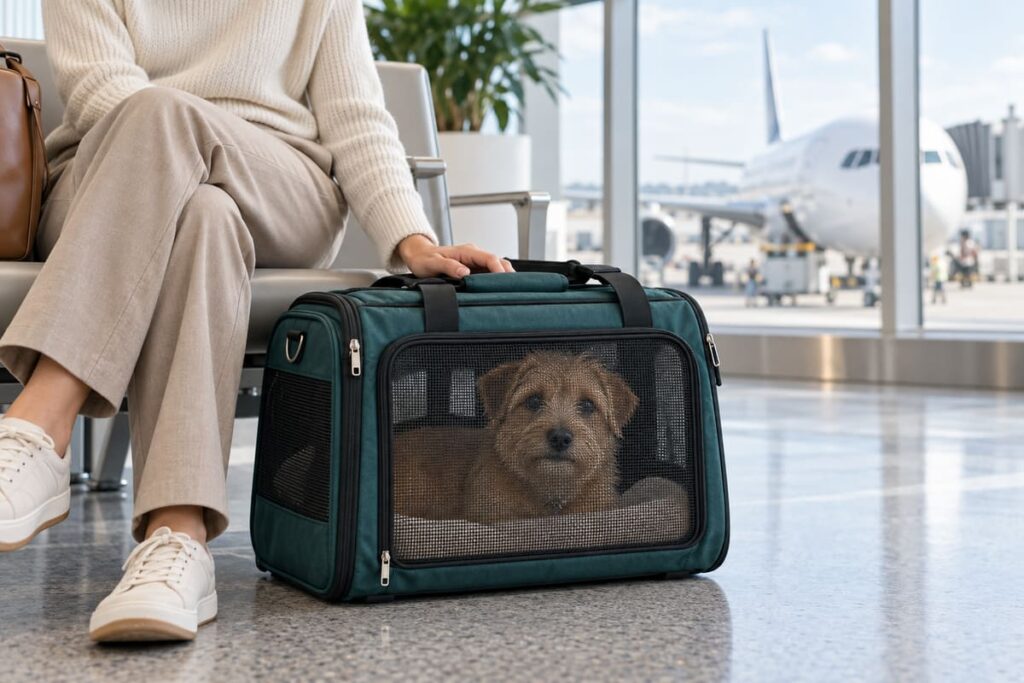
Yes—you can carry a pet on many flights in the United States, but a passenger ticket does not automatically reserve space for an animal. Whether your pet can join you depends on the airline, route, aircraft, available pet spaces, and whether your pet fits comfortably in an accepted carrier.
For a small cat or dog, that often means traveling in a carrier beneath the seat ahead. Larger pets need a different arrangement, and not every airline offers one. This guide explains what to confirm before booking, how to prepare for security, and how to choose a carrier that suits both your pet and your flight.
Policy information checked September 28, 2026. Recheck your operating airline’s rules before booking and before departure.
Three ways pets may travel by air
Start by asking which service is available for your exact itinerary. “Pets allowed” can mean very different things.
| Travel option | What it means | What to confirm |
|---|---|---|
| In the cabin | Your pet accompanies you in an accepted carrier, usually beneath the seat ahead. | Species, carrier fit, pet-space availability, and eligible seats. |
| Checked pet | Your pet travels outside the passenger cabin under a specific checked-animal service. | Whether the airline offers it and whether you qualify. |
| Cargo | Your pet travels through a separately arranged animal-shipping service. | Route availability, crate rules, handover location, weather restrictions, and cost. |
The FAA explains that airlines decide whether to accept pets in the cabin. A cabin carrier must fit beneath a seat without obstructing access to the aisle, and you must follow crew instructions for stowage. Airline rules may also require your pet to remain inside for the entire flight.
Do not arrive expecting a cabin-ineligible pet to be checked like a suitcase. For example, American restricts its checked-pet service to qualifying active-duty US military and State Department personnel traveling on official orders. Other owners need to explore an eligible cargo service or a different travel plan.
US airline pet policies: two useful examples
These examples show why it pays to check the actual airline rather than rely on a carrier’s product label. They are a starting point, not a complete list of restrictions or an endorsement of either airline.
| Airline | Cabin pets | Published fee example |
|---|---|---|
| American Airlines | Eligible cats and dogs; age, size, destination, and aircraft restrictions apply. | $150 per kennel each way on eligible routes. Longer connections can trigger additional fees. |
| Delta Air Lines | Eligible small dogs, cats, and household birds on domestic flights within the contiguous US. | $150 USD/CAD each way for the listed US/Canada/Puerto Rico/US Virgin Islands fee category on tickets issued on or after April 8, 2025; currency and route restrictions apply. |
Budget for the pet fee separately from your ticket, plus any required veterinary visit or new carrier. Ask about every leg, including the return flight. On a codeshare itinerary, confirm the rules of the airline actually operating each flight.
Before paying, ask: “Is there a pet space available on every flight in this booking, is my seat eligible, and what is the total pet fee for this itinerary?” Save the confirmation with your travel documents.
How to choose a carrier for the cabin
A carrier has to pass two checks: it must fit the airline’s permitted space, and your pet must fit comfortably inside. Weight alone cannot tell you both. Measure the carrier’s outside length, width, and height, then review your pet’s usable space with the carrier closed.
For example, American’s cabin-carrier rules require your pet to fit comfortably inside the closed or zipped carrier. Soft-sided carriers must fit under the seat without excessive collapsing. A bag that fits only by crowding your pet is not a suitable choice.
Delta recommends a soft-sided carrier up to 18 × 11 × 11 inches for most aircraft types, but its actual limits depend on the aircraft. That recommendation is not a universal size standard for other airlines or a guarantee for every Delta seat.
- Look for secure closures and ventilation panels that remain unobstructed when the carrier is in position.
- Check the base, liner, handles, and seams before travel—not for the first time at check-in.
- Keep the model name and measured dimensions in your booking notes.
- If an aircraft change affects the available space, ask the airline to reconfirm the fit.
Treat “airline approved” wording as a prompt to investigate, not a boarding guarantee. The useful question is whether this carrier, with your pet inside, meets the rules for your booked flight.
Do you need a health certificate or other paperwork?
There is no single document checklist that covers every domestic trip. USDA APHIS says the receiving state or territory sets its pet-entry requirements. Those can include health certificates, vaccinations, testing, or treatments. Check the destination’s requirements as well as the airline’s, and ask your veterinarian about any deadlines.
Hawaii needs separate advance planning. Its official animal-quarantine guidance explains the entry programs and preparation required for dogs and cats. Do not assume a mainland domestic itinerary has the same requirements.
For an international trip, start with USDA’s destination-specific travel guidance. Some destinations require a health certificate completed by a USDA-accredited veterinarian and endorsed by USDA. Preparation can take weeks or months.
If you are returning to the US with a dog, also check the CDC’s dog-entry requirements. The applicable process depends on the dog’s vaccination history and the countries it visited in the previous six months. Airline acceptance and border-entry permission are separate checks.
How to take a pet through TSA security
Your pet must not go through the baggage X-ray machine. The empty carrier is screened separately. Tell the officer you are traveling with an animal and follow instructions about handling your pet and its leash or harness. TSA’s travel guidance specifically requires removing pets from their carrying cases for screening.
- Have your travel documents accessible before joining the line.
- Tell the officer if your pet is nervous or may try to escape.
- Remove your pet when instructed and send the empty carrier for screening.
- Follow the officer’s directions for screening you and your pet.
- Once cleared, secure your pet in the carrier before reorganizing the rest of your bags.
If opening the carrier in a crowded checkpoint could lead to escape, ask about private screening before unzipping it. TSA advice published by Buffalo’s airport authority recommends requesting a private room for animals likely to struggle or jump away. Allow extra time for the process.
A practical preflight packing checklist
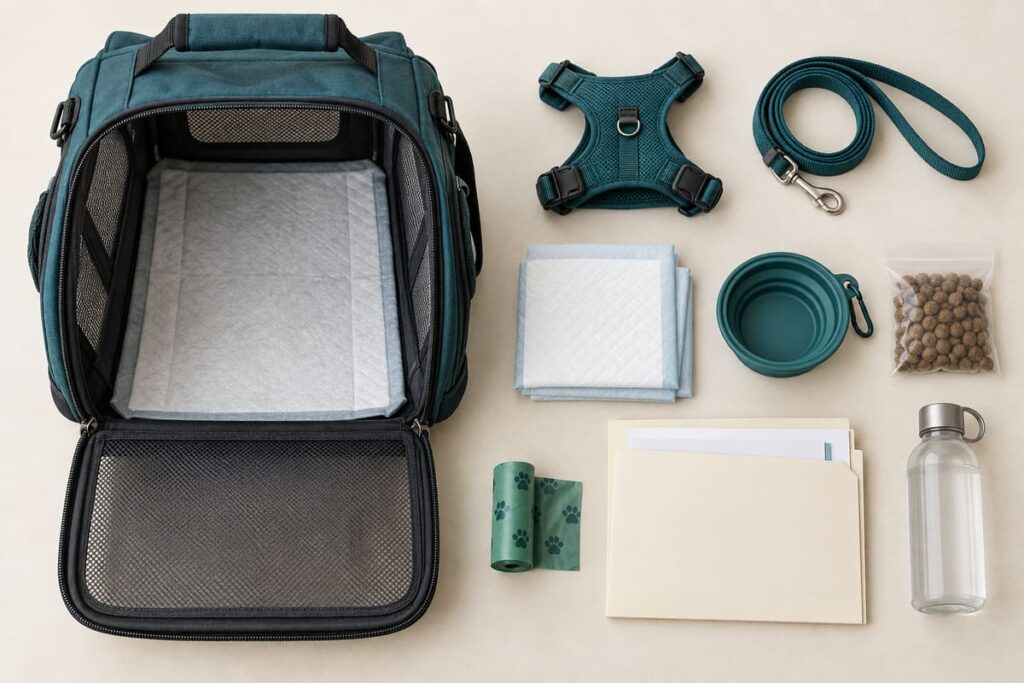
Pack the small essentials together so they are easy to reach without opening your pet’s carrier unnecessarily. Use this as a planning list, then adjust it to your airline, destination, and veterinarian’s advice.
- Your pet reservation confirmation and the airline’s current carrier requirements.
- Required health, vaccination, identification, and entry documents.
- A suitable carrier with an absorbent liner and a spare liner.
- A well-fitting harness and leash for controlled handling when appropriate.
- A collapsible bowl, food, waste bags, and basic cleanup supplies.
- A recent pet photo and up-to-date owner contact information.
- Any prescribed medication in its labeled packaging, with veterinary instructions.
TSA liquid restrictions still apply to ordinary liquids. Pack an empty bottle to refill after security rather than assuming a full bottle for your pet is exempt.
Help your pet prepare before travel day
Give your pet time to become familiar with the carrier at home. Begin with a quiet, open carrier, reward calm investigation, and build up to short periods inside. Practice gradually rather than making departure day the first experience of a closed travel bag.
For cats, our calm guide to getting a cat into a pet carrier offers a useful starting point. Keep training sessions manageable, and speak with your veterinarian if your pet shows substantial travel anxiety.
The American Veterinary Medical Association highlights additional air-travel risks for short-nosed pets and recommends avoiding tranquilization for air travel. Do not give a sedative or a new calming product on your own. Ask your veterinarian whether flying is appropriate for your animal and what preparation or treatment, if any, is suitable; also check the airline’s medication restrictions.
Service dogs follow different rules from pets
Under the US air-travel rules summarized by the Department of Transportation, a service animal is a dog individually trained to perform work or tasks for a person with a disability. Emotional-support animals and service animals in training are not included in that definition.
Airlines may require DOT service-animal forms. An emotional-support designation does not automatically provide free cabin travel or remove ordinary pet restrictions. If your animal is a trained service dog, use the airline’s service-animal process rather than its pet-reservation process.
Frequently asked questions
Can I hold my pet on my lap during the flight?
For ordinary cabin pets on American and Delta, plan to keep your pet secured in its carrier as required by their policies. Do not open the bag for a lap visit. Trained service animals are governed by a separate set of rules.
Can a large dog fly in the cabin?
If a pet cannot fit comfortably in the required cabin carrier, the standard under-seat pet option will not work. Ask about other eligible transport services or consider a different way to travel. Do not assume buying an extra seat changes the carrier rules.
Does passing TSA mean the airline has approved my pet?
No. Security screening and airline acceptance are different steps. Your pet still needs to meet the carrier, reservation, route, and documentation requirements for the flight.
Is there one pet weight limit for all US airlines?
No single number answers the question for every booking. Read your operating airline’s current rules and check both carrier dimensions and the space your pet needs. A pet’s weight alone does not establish a comfortable fit.
What if my pet cannot travel on the flight I booked?
Contact the airline before departure to discuss available changes. Keep a backup plan—a different itinerary, a suitable ground journey, or a trusted caregiver—rather than relying on an exception at the gate.
Your next step: confirm the flight before choosing the bag
Start with the operating airline and your pet’s needs. Once the route, available pet space, and carrier requirements are clear, you can compare options with confidence. Keep written notes of the rules you checked and review them again before traveling.
For more preparation ideas, explore our pet carrier and travel guides. Retailers and pet brands planning a carrier collection can also contact our wholesale team to discuss product specifications.
Images in this article are original AI-generated illustrations, not airline endorsements or evidence that a particular carrier is accepted on every flight.